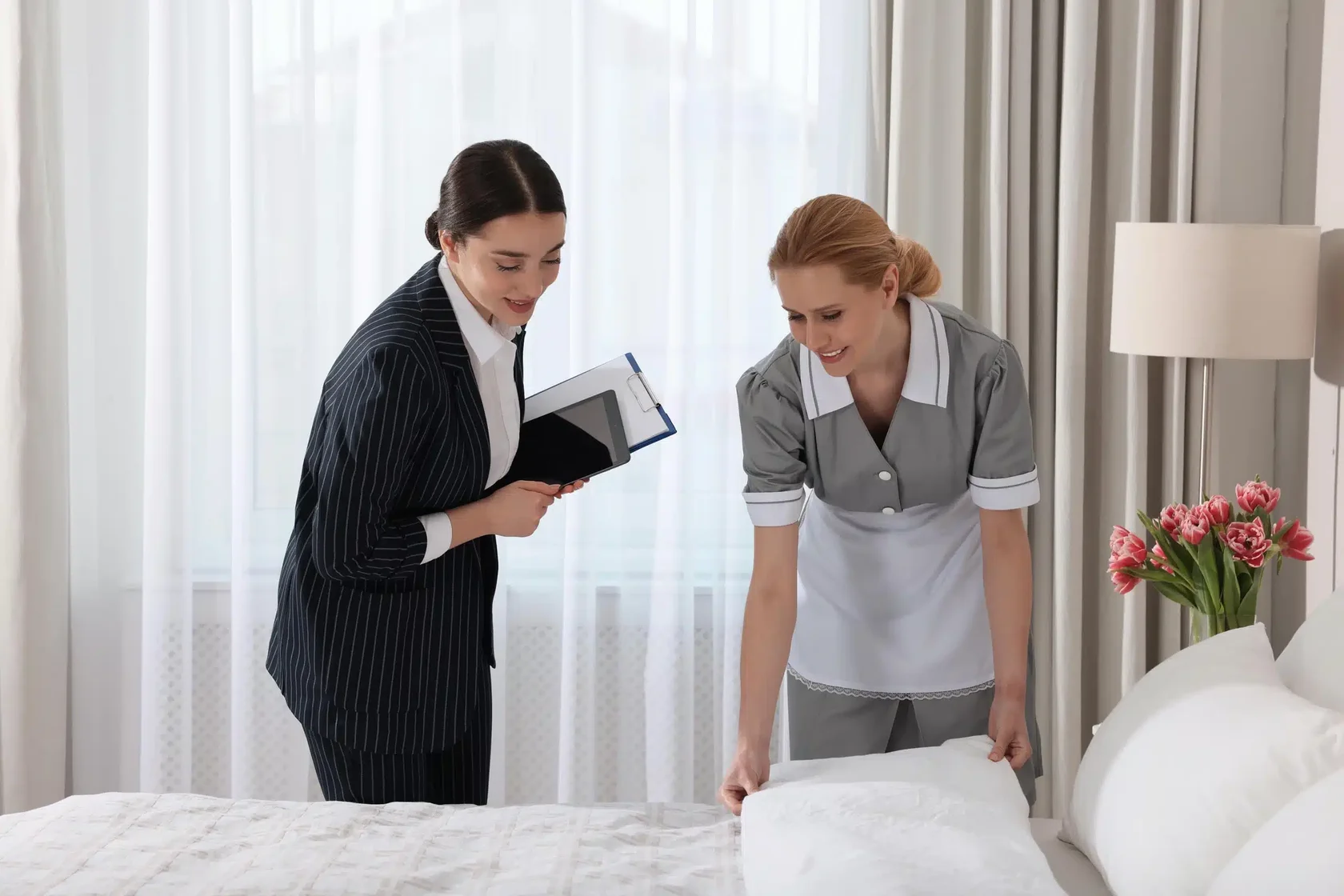
She's the person guests rarely see — but the one whose work determines whether they'll come back. A room attendant's performance is shaped long before she picks up a cloth. It starts with how she prepares, how she's managed, and whether the systems around her are set up for success or failure.
Here's what a productive day actually looks like — and where things typically go wrong.
Here's what a productive day actually looks like — and where things typically go wrong.
The Structure of a Room Attendant's Day
Stage 1. Getting ready for the shift
Before the shift starts, an attendant's appearance should meet the property's grooming standard:
- Hair tied back and secured (with a net in food-adjacent environments)
- Clean, pressed uniform with a name badge
- Closed-toe shoes with a fixed heel and non-slip sole — color matching the uniform
- No heavy makeup, nail polish, or jewelry. Small earrings are acceptable. Wedding rings should come off — rubber gloves are difficult to put on and remove with a ring, and it slows the entire day down.
This isn't vanity. An attendant who doesn't take care of her own appearance will not take care of the details in a guest room. It's a reliable predictor — and experienced managers know it.
Stage 2. The morning briefing
Every shift should begin with a 15-minute briefing. This is where the attendant receives her daily assignment, learns about occupancy, guest requests, any special notes from the night before, and feedback from recent inspections.
The manager or supervisor also runs a short training refresher — a single topic, 3–5 minutes. It keeps cleaning standards top of mind and prevents the slow drift that happens when skills aren't reinforced regularly.
Stage 3. Cart preparation
After the briefing, the attendant prepares her cart. This means mixing cleaning solutions, filling spray bottles, and loading everything needed for the assigned rooms: chemicals, cloths, sponges, mops, vacuum, guest amenities, linen, toiletries, printed materials, and minibar supplies.
A photo of the correctly loaded cart should be posted in the housekeeping office as a visual reference. Every cart should also carry a bottle of hand sanitizer. After removing gloves post-cleaning, the attendant must sanitize her hands and forearms before touching any clean linen, making beds, or restocking the minibar.
Stage 4. Room cleaning
The daily assignment typically includes a mix of:
- Checkout rooms (usually cleaned first — they need to be guest-ready for new arrivals)
- Stay-over rooms (occupied rooms receiving daily service)
- Deep cleans (periodic thorough cleaning beyond the daily scope)
How many rooms an attendant cleans per shift depends on the property's established productivity standard, shift length, and room size and category.
Between rooms, the attendant also maintains her floor storage closet — restocking linen, amenities, toilet paper, and slippers throughout the day. The initial cart load never covers a full shift. Regular closet runs are part of the workflow.
The link between organization and quality is direct. An attendant who keeps her cart and closet in order doesn't waste time searching for supplies. She knows exactly where everything is, moves faster, and produces more consistent results. An attendant who works from a messy cart will clean rooms the same way — surface-level, disorganized, and full of missed details.
Productivity isn't just about room count. It's room count multiplied by quality. A supervisor who checks 14 rooms and finds 6 need rework hasn't gained anything.
The link between organization and quality is direct. An attendant who keeps her cart and closet in order doesn't waste time searching for supplies. She knows exactly where everything is, moves faster, and produces more consistent results. An attendant who works from a messy cart will clean rooms the same way — surface-level, disorganized, and full of missed details.
Productivity isn't just about room count. It's room count multiplied by quality. A supervisor who checks 14 rooms and finds 6 need rework hasn't gained anything.
Stage 5. End-of-shift cart maintenance
At the end of the shift, the attendant:
- Removes all remaining supplies and linen from the cart
- Wipes down every surface with cleaning solution
- Disinfects all shelves and compartments
- Cleans and disinfects all cleaning tools (mops, brushes, sponges)
- Replaces any soiled fabric bags with clean ones
A clean cart at the end of the day means a fast start tomorrow.
How to Spot Problems Before They Reach the Guest
Watch the briefing closely
The morning briefing isn't just about assigning rooms. It's your best diagnostic tool.
If an attendant arrives sick — coughing, sneezing, visibly unwell — send her home. One sick attendant working through a shift spreads illness to the team and to guests. The short-term staffing gap is cheaper than the long-term fallout.
If an attendant is visibly upset, hostile, or withdrawn — don't ignore it. A brief private conversation after the briefing can reveal personal problems, workplace conflicts, or early signs of burnout. An attendant in a bad mood will clean carelessly and respond poorly if she encounters a guest in the hallway.
If an attendant's appearance is sloppy — wrinkled uniform, messy hair, no badge — expect the same standard inside the rooms she cleans. She'll wipe the visible part of a desk and skip the sides. She'll make the bed but not check under it. The supervisor will spend double the time re-inspecting and correcting. Address it directly, one-on-one, and determine whether it's a training issue or a discipline issue.
Don't delegate every briefing
Managers who always hand briefings to supervisors lose touch with their team. Regular presence at morning meetings — even two or three times a week — lets you observe mood, energy, and small behavioral shifts that signal bigger problems. The housekeeping team creates the emotional atmosphere of your hotel. If they're unhappy, guests will feel it.
Use multi-layered quality checks
Quality shouldn't depend on a single person's inspection. Build a system with multiple layers:
- Self-checks: Attendants inspect their own rooms using a scored checklist before marking them complete
- Peer checks: Attendants occasionally inspect each other's rooms — this builds accountability and shared standards
- Supervisor checks: Random spot inspections with scored checklists
- Manager checks: Periodic walk-throughs focused on both room quality and attendant well-being
Track all scores in a shared log so each attendant can see her performance over time — from her own eyes, her colleagues', and her supervisors'. This eliminates subjective bias and makes it clear when someone needs additional training versus when a system-wide refresher is needed.
What Kills Efficiency — And How to Fix It
No motivation system
Money matters — but it's not the only thing. Research consistently shows that a simple "thank you" from a manager after a tough shift has a measurable impact on performance and retention.
Effective motivation includes:
- Financial: Bonuses, performance pay, shift premiums for peak periods
- Recognition: Verbal praise, birthday greetings from the GM, employee-of-the-month programs
- Care: Meals on shift, uniform laundering, health insurance, conflict resolution support, paid training time
- Growth: A clear, transparent career path. An attendant who knows she can become a supervisor — and knows exactly what steps are required — works differently than one who sees no future in the role
- Purpose: For attendants who don't want management roles, offer a mentorship track. Let experienced staff train newcomers. It gives them status, variety, and a reason to maintain high standards
Motivation resources are abundant. They just need to be managed intentionally.
Weak onboarding and training
A new hire who's handed a cart and told "follow Maria today" is not being trained. She's being abandoned.
Effective onboarding is structured in stages, with a designated mentor, clear milestones, and gradual responsibility increases. The new attendant should never feel overwhelmed or unsupported during her first weeks.
After onboarding, skills need ongoing reinforcement. That's what the daily 15-minute briefing is for — short, focused, consistent. Without it, standards erode within weeks.
Burnout
When an experienced attendant starts making unusual mistakes, taking longer than normal, or showing emotional flatness — it's usually burnout. Physical and emotional exhaustion makes quality impossible.
Don't push harder. Step back, identify the cause (overwork, personal issues, lack of recognition, schedule problems), and give the person space to recover. A burned-out attendant who quits costs you far more than a few days of adjusted workload.
Poor support from other departments
Sometimes the problem isn't the attendant — it's everything around her. Efficiency drops when:
- She has to walk to the laundry herself to drop off dirty linen and collect clean sets — instead of having it delivered to her floor
- Clean linen arrives with stains or damage that's invisible when folded — forcing her to return it and wait for replacements
- Maintenance issues in rooms aren't resolved between stays, adding unexpected tasks to her cleaning routine
An attendant's job should be cleaning guest rooms. If she's spending significant time on logistics that should be handled by other departments, the problem is organizational — not individual.
How to Measure Attendant Performance
Four practical tools:
1. Scored checklists. Used by the attendant herself, her peers, supervisors, and managers. Multiple perspectives eliminate bias.
2. Guest reviews. Monitor OTA reviews, on-site feedback cards, and direct complaints. Cleanliness comments — positive or negative — are direct reflections of your team's work.
3. Checkout surveys. A short questionnaire at departure specifically asking about room cleanliness, comfort, and any issues noticed.
4. Time tracking. Not to micromanage — but to identify patterns. If an attendant's room times are increasing over weeks, something has changed. Investigate before it becomes a performance issue.
The Bottom Line
A room attendant's effectiveness is never just about the attendant. It's about the system she works in: how she's briefed, equipped, trained, motivated, supported, and managed.
The hotels that consistently deliver spotless rooms aren't the ones with superhuman staff. They're the ones where managers pay attention to the small signals, where training never stops, and where the housekeeping team feels seen — not just supervised.
Your guests will never meet your housekeeping manager. But they'll experience the culture she creates, in every room, every day.